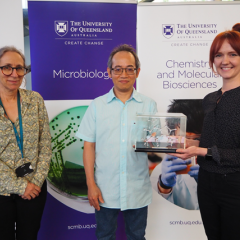
COPE is delighted to announce that Professor Paul Burn FRSC and Australian Research Council Federation Fellow has been elected to a Fellowship at the Australian Academy of Science.
For more information on this please click here and this link here....Read more
Three COPE postgraduate students have won prizes as top UQ performing tutors for second semester 2011. Andrew Clulow, Ross Jansen-Van Vuuren and Ellen Wren achieved a score of 4.80 or better out of 5.0 for their overall performance evaluated by students. The winners received a certificate and a movie voucher, and attended a luncheon hosted by the Head of School, Professor Melissa Brown. Congratulations to all the winners.

To read more about this please click here: http://www.scmb.uq.edu.au/congratulations-to-outstanding-tutors...Read more
COPE is delighted to announce that Dr Ebinazar Namdas has won a prestigious Future Fellowship from the Australian Government.
Dr Namdas has been awarded a four-year Future Fellowship to conduct research into organic-inorganic hybrid electronic devices and logic circuits. The project will create the next generation of opto-electronic devices and logic circuits using solution-based organic-inorganic hybrid materials that have the potential of being extremely cheap, recyclable, and mechanically flexible....Read more
COPE is delighted to announce that Dr Almantas Pivrikas and Dr Paul Shaw have won Australian Research Council Discovery Early Career Research Awards (DECRAs). DECRAs recognise outstanding young researchers of exceptional promise. The awards are in two key areas of organic optoelectronics, namely charge transport and photophysics....Read more
COPE PhD student Justin Yu has successfully won both the SCMB qualifier round and the Faculty of Science semi-final to compete at the UQ 3 Minute Thesis competition Final.
The Three Minute Thesis (3MT) is a research communication competition developed by The University of Queensland. Participating students have three minutes to present a compelling oration on their thesis topic and its significance.

...Read more
As part of National Science Week, COPE senior research fellow Dr Kwan H. Lee will be presenting a public talk titled "Organic Electronics - The future is NOW" on Sunday 21 August 2011 at 1.00pm at the Queensland Museum....Read more


Researchers at COPE have recently been featured on the cover of Advanced Functional Materials. Stable film morphology is critical for durable, high-performance organic light-emitting diodes. Uniformly blended films of Ir(ppy)3 in CBP formed by evaporation were found to phase-separate with moderate heating. Luminescence microscopy shows that phase separation leads to fiber-like structures of CBP (blue) and Ir(ppy)3 (green)....Read more
COPE hosted a group of collaborators from Germany from 6th to 10th June 2011. The visitors included Dr Alexander Colsmann, Andreas Pütz, Jens Czolk and Michael Klein from Karlsruhe Institute of Technology, Prof Klaus Lips from Helmholtz Center Berlin and Dr Jan Behrends from Free University Berlin.
The Centre is currently advertising several new postdoctoral research positions as it continues to expand. Positions are available in organic field effect transistors fabrication and testing, organic optoelectronic materials synthesis, the physical deposition of transpare...Read more
A postdoctoral research position is available in COPE in the field of Theory of Organic Optoelectronic Materials. To find out more about this position, please click here. Further information is available on the ...Read more
Australia's leading research chemists have thrown themselves in the mix when it comes to celebrating the 2011 International Year of Chemistry.
UQ's chemistry researchers, whose work consistently ranked as above world standard in more fields than any other Australian university in the recent Excellence in Research for Australia (ERA) ratings, are enthusiastically taking up the call to increase the profile of the chemistry discipline as part of the international celebrations....Read more
Giant particle accelerators such as the large hadron collider have generated enormous interest for their potential to shed light on the secrets of the universe. While the LHC is answering fascinating fundamental questions, lower-energy particle accelerators focused on problems of a more practical nature have recently produced an interesting breakthrough in our ability to control the electrical properties of plastics. ...Read more
Materials Today have highlighted an important breakthrough made by COPE members Andrew Stephenson, Kwan Lee, Paul Meredith and Ben Powell in collaboration with Adam Micolich and the University of New South Wales.
You can now view the Class 1000 Cleanroom located in COPE in a virtual tour. Click here to view the virtual tour. (Please note that the ability to view this will depend on the software you have installed on your computer.)
...Read more

Ben Powell, Seth Olsen and Paul Burn have just been awarded 600,000 hours of cpu time from the National Computer Infrastructure via the Merit Allocation Scheme. This resource will be vital for our continuing computational research effort.
Today the Australian Research Council (ARC) announced $250,000 in support for the project "High pressure facility for optical spectroscopy: investigation of novel superconductors and strongly correlated electrons systems". This facility is a multi-institution collaboration including Clemens Ulrich (UNSW), Xaolin Wang (Wollongong) and Annemieke Mulders (UNSW@ADFA) as well the two COPE researchers.
Two COPE postgraduate students, Hamish Cavaye and Ross Jansen-van Vuuren, recently won prizes at the School of Chemistry and Molecular Biosciences Postgraduate Research Students Symposium held in November 2010. Congratulations to both Hamish and Ross on their excellent presentations....Read more
.jpg)
Everyone at COPE is delighted to hear that Dr Ben Powell has been promoted to Associate Professor. Congratulations, tnis is an extremely well deserved achievement!
Two COPE members, Dr Hellen Hui Jin and Dr George Vamvounis were recently successful in obtaining Early Career Researcher grants funded by The University of Queensland.
Dr Jin's research is aimed at improving the efficiency of plastic solar cells by device design and Dr Vamvounis will focus on exploring the development of new molecules for memory devices....Read more
Today Max Lu UQ Deputy Vice Chancellor (Research) congratulated the 92 successful Discovery grants from UQ. In doing so he highlighted 10 grants as particularly significant. One of which was Seth Olsen's!

Everyone at COPE would like to congratulate Seth Olsen on being awarded an Australian Research Fellowship (ARF). This prestigious five-year fellowship had a success rate of just 13%, so Seth had to beat off some stiff competition. We at COPE are pleased that this fellowship will keep Seth at COPE for the next five years.

Andrew Clulow, a postgraduate student in COPE, has won a prize as one of the top 14 performing tutors in the School of Chemistry and Molecular Biosciences for first semester 2010. Performance was assessed on SET-T results and staff feedback return-to-course score. Well done Andrew.
The COPE team congratulate Mr Dr Andrew Stephenson on being awarded his postdoctoral degree. The title of his thesis is "Electrical Properties, Tunability and Applications of Superconducting Metal-Mixed Polymers." Well done Andrew and we wish you all the best with your future career.

The Prime Minister Julia Gillard visited The University of Queensland on 23rd July 2010 and announced that a Labor Government would form a "citizens' assembly" of up to 200 people who would seek community views about putting a price on carbon (ABC News.)...Read more

Ben Langley, a COPE student who is nearing the completion of his postdoctoral degree, recently won a prize for his poster entitled "Enhancing the properties of dendritic Ru(II) complexes for Dye Sensitised Solar Cells" at the CIMOPV Workshop.
...Read more
Paul Burn has been admitted as a Fellow of the Royal Society of Chemistry. The RSC is the largest organisation in Europe for advancing the chemical sciences. Supported by a worldwide network of members and an international publishing business, their activities span education, conferences, science policy and the promotion of chemistry to the public. Further information on the Society is available at http://www.rsc.org....Read more
Royal Society of Chemistry Headquarters, LondonDr Yuan Fang joined the growing COPE team in April 2010 as a Post-doctoral Research Fellow. He hails from Hubei in China, and obtained his doctoral degree from Sun Yat-sen University in December 2009 majoring in Materials Physics and Chemistry.
Dr Lee joins the team at COPE in January 2010. His research will focus on developing high performance hybrid photovoltaic cells and will bring an extra dimension to the organic photovoltaics research that is being conducted within COPE. In a hybrid photovoltaic cell, the organic semiconductor is modified by incorporating inorganic nanoparticles into the organic layer. This is expected to combine the benefits found in both organic semiconductors (flexibility, low cost) and inorganic semiconductors (high carrier mobility, material tuneability.)

...Read more
An interdisciplinary team of chemists and physicists from UQ and Harvard, including COPE’s Ben Powell, have performed the world’s first quantum chemistry calculation on a quantum computer. Their results were published this week in Nature Chemistry. This result has already been reported by a wide range of news sources including New Scientist and Yahoo News.
Everyone at COPE would like to extend their warmest congratulations to Byeong-Kwan An who has been appointed to a Faculty position at the Department of Chemistry, The Catholic University of Korea. BK has done outstanding work during his time as a member of COPE and he will be a big loss to the Centre. We wish BK all the best for his future.
Ben Powell, Seth Olsen, Paul Burn and Ross McKenzie have been awarded half a million CPU hours (with an in-kind value of $250,000) as part of a "superproject" on the National Computational Infrastructure's (NCI) National Facility under the merit allocation scheme. This grant will enable a wide range of computational work at COPE supporting experimental and theoretical work across the whole range of the centre's interests.

Professors Paul Meredith and Paul Burn, and Dr Muhsen Aljada at the Centre for Organic Photonics & Electronics at the University of Queensland have been awarded a $945k grant for a project entitled: New Materials and Architectures for Organic Solar Cells - Beyond the Shockley-Queisser Limit from the Australian Solar Institute (http://www.australiansolarinstitute.com.au/news.htm)
Two PhD students from COPE, Hamish Cavaye and Benjamin Langley, received awards for their work at the recent SCMB Research Students Symposium.

Hamish Cavaye with his poster at the Research Students Symposium...Read more
Solution-processable blue phosphorescent emitters with high luminescence efficiency are highly desirable for large-area flat panel displays and lighting applications. For most of phosphorescent blue materials, the luminescent efficiency tends to decrease while going to deeper blue. Researchers in COPE have developed a strategy to reduce the non-radiative decay rate in deep blue phosphorescence by encapsulating blue phosphorescent core into a new class of rigid high-triplet energy dendrons. This gives a solution-processable blue dendrimer with solution and film photoluminescence quantum yields of 94% and 60%, respectively. Click here to view the article.

The success of three important funding proposals by COPE researchers was announced recently by the ARC. Dr George Vamvounis, a COPE postdoctoral research fellow, was awarded a prestigious Australian Research Fellowship for five years. Prof Ross McKenzie obtained funding from the ARC to conduct research for optimising information storage. Dr Ben Powell and Dr Lawrence (Shih-Chun) Lo won an ARC discovery grant which will enable them to conduct research into the way electrons behave in new materials.
An important publication has just been published online in the journal Soft Matter, entitled "The supramolecular structure of melanin". Click here to view the article.
COPE researchers have received almost $2 million from the Queensland Government to lead an international alliance working on the next generation of solar cells.
The researchers, Professor Paul Burn and Associate Professor Paul Meredith from the Centre for Organic Photonics & Electronics, focus on solar cells that have the potential for wide commercial deployment – they're plastic, portable and low-cost.
“Solar cells are widely viewed as an important pillar of the future renewable energy technology mix,” Professor Burn said.
“The objective of this research alliance is to develop innovative technologies for the next generation of solar cells, which will be based on inexpensive and environmentally friendly plastic materials.”
Associate Professor Meredith said presently the best commercially available solar cells were based on silicon and had efficiencies of about 10-20 percent.
“As a result of the cost and complexity of processing silicon, it takes five to 10 years electricity generation to pay off the initial outlay; a fact that hinders universal up-take, especially for households, in the current economic framework,” he said.
To read more please click here:...Read more
Andrew Clulow and Muhsen Aljada have won prestigious Trailblazer Awards. The Trailblazer Awards, run by UniQuest Pty Ltd (www.uniquest.com.au), are recognition of cutting-edge thinking and innovations with the potential to benefit industry and the community.

In a series of four articles by academic researchers in the Centre, COPE was highlighted in the June 2009 issue of the monthly magazine published by the Royal Australian Chemical Institute, Chemistry in Australia....Read more

Prof Paul Burn has recently been appointed to the Editorial board of a new Royal Society of Chemistry Journal, 'Polymer Chemistry'. This journal will encompass all aspects of synthetic and biological macromolecules, and related emerging areas. The new journal will provide a showcase for the ongoing efforts driving polymer chemistry, highlighting the creativity of the field and previously inaccessible applications.
![]()
Three physicists from COPE and SMP have reported the discovered a new ratio that takes the same predicted value in a wide range of strongly correlated materials.
Flex Tech, a global alliance for focussing on flexible electronics, highlights the opening of COPE in their December 2008 newsletter.
National review recommends a major overhaul of Australia's system of research innovation....Read more
The Centre for Organic Photonics and Electronics was officially opened by Professor Paul Greenfield on 18 November 2008....Read more
The opening of the Centre was showcased in the 14 November 2008 issue of Photonics World.

Ben powell wins UQ Foundation Research Excellence award...Read more
Listen to the discussion here between Paul Burn and Robyn Williams which focuses on new photovoltaic plastics. This took place on 18 October 2008 on the Science Show (Radio National.)